The False Joker in Okey: What It Stands For and What It Counts
Last updated:
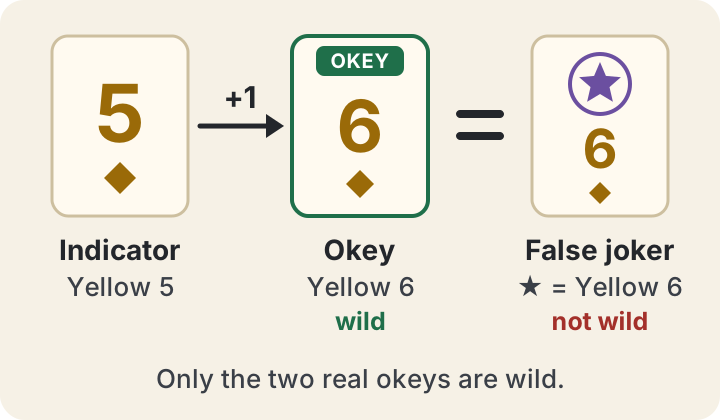
The false joker (★) is one of two special tiles in an okey set, and it is not wild. It stands for the tile that is the okey in that hand and plays only as that tile's colour and number. If the indicator is Yellow 5, the okey is Yellow 6: both false jokers play as Yellow 6 and count 6. Only the two real okeys are wild.
Think of the false joker as the okey tile itself. If the okey is Yellow 6, the ★ in your rack is a Yellow 6 as well, and it stands for no other tile. This page explains how oyna.app plays that rule in Okey 101 and in Classic Okey (düz okey, the 14-tile game). Some details vary from table to table; you will find them further down.
What does the false joker stand for?
The false joker stands for the tile that is the okey in that hand: the indicator’s colour, one number higher. If the indicator is Yellow 5, the false joker is a Yellow 6. The indicator (gösterge) settles this at the start of every hand:
- The indicator is turned face up.
- The okey is the next number in the indicator’s colour. If the indicator is a 13, the okey is the 1 of that colour.
- The false joker is the okey tile itself: the same colour and the same number.
| Indicator | Okey (wild) | ★ plays as | ★ counts |
|---|---|---|---|
| Yellow 5 | Yellow 6 | Yellow 6 | 6 |
| Red 9 | Red 10 | Red 10 | 10 |
| Blue 12 | Blue 13 | Blue 13 | 13 |
| Black 13 | Black 1 | Black 1 | 1 |
Why does the game need it? An okey set has 106 tiles: two of every number from 1 to 13 in four colours (104 tiles), plus the two false jokers. Once the two okey tiles turn wild, the set has no ordinary Yellow 6 left. The false jokers take the place of those two tiles.
The indicator is always a numbered tile; on oyna.app a false joker is never the indicator. The indicator stays face up in the middle for the whole hand and stands in for no other tile. Its twin (the second Yellow 5 in the example) is an ordinary tile as well.
Is the false joker wild?
No. A real okey can stand for any tile you need; a false joker stands only for the okey tile. Under oyna.app’s 101 rules the difference looks like this, with Yellow 6 as the okey:
| Okey (2 tiles) | False joker (2 tiles, ★) | |
|---|---|---|
| What it stands for | Any tile | Only Yellow 6 |
| What it counts when you open | The number of the tile it stands for | 6 |
| Left in your hand when the hand ends | 101 | 6 |
| Discarded | +101 penalty | No penalty; +101 if it is a playable tile |
| Thrown as your last tile | A finish with the okey: the scores double | An ordinary finish |
| Taken back from the table | Yes, by putting down the tile it stands for | No: it is an ordinary tile |
The row “Left in your hand” shows what a player who opened with sets or runs scores when someone finishes in the ordinary way. A player who opened with pairs scores 12 for the false joker, and a player who never opened scores 202 whatever their tiles. The details are below.
False joker, fake joker or sahte okey?
The tile goes by several names. Turkish players call it sahte okey, literally “fake okey”. English rule books call it the false joker, and you will also see “fake joker”. All three mean the same two tiles, which carry a star or another symbol instead of a number. The okey, meanwhile, is the game’s joker, so the word “okey” names both the game and the wild tile; on this page “the okey” always means the tile.
The 21-tile game is known as Okey 101 or 101 Okey. The 14-tile game, which English reference works simply call okey, is Classic Okey on oyna.app. The false-joker rule is the same in both.
Melds with a false joker: examples
With Yellow 6 as the okey (indicator Yellow 5), the false joker is a Yellow 6 in every run and every set:
| Meld | Valid? | How it reads | Opening points |
|---|---|---|---|
| Yellow 5 · ★ · Yellow 7 | Yes | The run Yellow 5-6-7 | 18 |
| ★ · okey · okey | Yes | Yellow 6-7-8 (the okeys as 7 and 8) | 21 |
| Red 6 · Blue 6 · ★ | Yes | Three colours of 6 (★ = Yellow 6) | 18 |
| Red 6 · Blue 6 · Black 6 · ★ | Yes | All four colours of 6 | 24 |
| Yellow 3 · Yellow 4 · ★ | No | ★ cannot be Yellow 5 | — |
| Blue 5 · ★ · Blue 7 | No | ★ cannot be blue | — |
| Yellow 3 · Yellow 4 · okey | Yes | The okey as Yellow 5 | 12 |
Under oyna.app’s 101 rules, what an okey stands for is read from the order in which you lined the group up on your rack (ıstaka), and the figures in the table follow that order. Put the same tiles down as okey · okey · ★ and the group is Yellow 4-5-6, worth 15; okey · Yellow 3 · Yellow 4 becomes Yellow 2-3-4, worth 9.
Pairs follow the same logic:
- Two false jokers make a pair: both are Yellow 6.
- A false joker and an okey make a pair as well, because the okey stands for its partner.
- A false joker and a Yellow 5 do not.
That holds when you are going for pairs in 101 (çifte gitmek: opening with at least 5 pairs) and when you finish Classic Okey with seven pairs.
Take care when the indicator is a 13. With Black 13 as the indicator, the false joker is Black 1. Under oyna.app’s 101 rules, which follow the common rule, the 1 is only the lowest tile: Black 1-2-3 is a run, Black 12-13-1 is not. In oyna.app’s Classic Okey, 12-13-1 is a run, so there the false joker can also follow the 13 as a 1 (Black 12-13-★).
What does the false joker count?
In 101 the false joker counts the okey’s number, both when you open and at the end of a hand. The figures on this page are the okey table’s own count (opening totals, penalty points, the points left in Classic Okey); they have nothing to do with the credits of an oyna.app account.
- When you open: With Yellow 6 as the okey, a false joker adds 6 to your opening. To open in 101, the melds you lay down must add up to at least 101.
- Left in your hand at the end: A player who has opened scores its number; after a pairs opening, twice that. When the finish is doubled, so is this figure.
The penalty that one false joker left in your hand scores, with Yellow 6 as the okey (oyna.app’s 101 rules):
| Finish | Multiplier | Opened with sets or runs | Opened with pairs |
|---|---|---|---|
| Ordinary finish | 1 | 6 | 12 |
| Finish with the okey, or a pairs opener’s finish | 2 | 12 | 24 |
| A pairs opener finishing with the okey | 4 | 24 | 48 |
The sum is the false joker’s number × the multiplier, then × 2 once more for a player who opened with pairs. The multiplier is 2 when the last tile thrown is a real okey, 2 when the finisher opened with pairs, and 4 when both are true. Compare a real okey: a player who has opened and still holds one scores 101 for it, and that 101 is never doubled.
A player who never opened is not charged tile by tile: they score 202 (404 or 808 when the finish is doubled). Going out in one go (elden: finishing in the turn you open, while nobody else has opened) is not counted tile by tile either: the finisher scores −202 and everyone else 404; with a real okey as the last tile, −404 and 808. With a false joker as the last tile the figures stay at −202 and 404.
In Classic Okey the tiles left in your hand do not count. The points count down from 20 instead (you can also start a game at 30, 40 or 50). The false joker makes no difference to that score: what matters is whether the last tile thrown is a real okey. Throwing a false joker as your last tile is an ordinary finish, and the other players (the other team in Team Okey) lose 2 points. Finishing by throwing a real okey is a finish with the okey, and they lose 4. When you finish with seven pairs, those figures are 4 and 8.
Is discarding a false joker a penalty?
In 101, no: discarding a false joker is not a penalty in itself. You are charged only when it is a playable tile (işlek), meaning that a run or a set on the table can take it. Then it costs +101.
- Playable, in a run: With Yellow 6 as the okey and Yellow 3-4-5 on the table, discarding the false joker costs +101, because the run grows with a Yellow 6.
- Playable, in a set: With Red 6 · Blue 6 · Black 6 on the table, the false joker (Yellow 6) fits as the fourth colour, so discarding it costs +101.
- Not playable: With Yellow 5 · okey · Yellow 7 on the table, the okey there already stands for Yellow 6. The false joker does not extend that run, and discarding it costs nothing.
Discarding a real okey costs +101, unless you throw it as your last tile and finish. In Classic Okey no discard is penalised.
Can a false joker take the okey back from the table?
At oyna.app’s 101 tables, yes, in one case only: when the okey on the table stands for the tile the false joker plays as. With Yellow 6 as the okey, that is an okey standing for Yellow 6. Once you have opened, you may, on your turn after drawing, put the tile an okey stands for in its place in a run, a set or a pair on the table and take the okey into your rack. Because the false joker is the okey tile itself, it frees only an okey that stands for that tile.
With Yellow 6 as the okey:
| Group on the table | What the okey stands for | Taken back with the false joker? |
|---|---|---|
| Yellow 5 · okey · Yellow 7 | Yellow 6 | Yes: put down the ★ and take the okey |
| Blue 4 · okey · Blue 6 | Blue 5 | No: it needs a Blue 5 |
| Red 6 · Blue 6 · Black 6 · okey | Yellow 6 | Yes |
| Red 6 · Blue 6 · okey | Yellow 6 or Black 6 | Only with the ★ and a Black 6 together |
| okey · okey (a pair) | Yellow 6 | Yes, one of the two okeys |
Worth knowing:
- You must have opened your hand first. You can also take an okey in the turn you open, once you have opened.
- An okey leaves a set only when all four colours are down; the missing colours go down together.
- The player whose okey you take is not penalised.
- You need not use the okey straight away. If it is still in your hand when the hand ends, it scores 101.
Classic Okey has no melds on the table, so there is no okey to take back.
What varies from table to table
Okey is played differently from one table to the next. What to know about the false joker:
- How the tile looks: In a physical set the false joker has no number; its pattern and symbol vary from set to set.
- Taking the okey back: At some tables an okey laid on the table stays there until the end of the hand and can never be taken back. At oyna.app’s 101 tables, as described above, a player who has opened may take it.
- 12-13-1: This differs between 101 and Classic Okey. In Classic Okey the 1 may also follow the 13; under the written rules of 101 it is only the lowest tile. oyna.app plays it that way: 12-13-1 is not allowed in 101 and is allowed in Classic Okey.
- The indicator: At tables where dice choose the indicator, a false joker that comes up goes back and a numbered tile is chosen instead. At some tables, if everyone agrees at the start, a player who shows the indicator while going for pairs may treat the indicator tile in their hand as if its twin were already there; oyna.app has no such rule.
If your table plays a different rule, agree on it before you start. On oyna.app the rule is the same at every okey table: only the two real okeys are wild, and the false joker is the okey tile itself.
How the false joker looks on oyna.app
On oyna.app the false joker is a star in a ring (★). Under the star you see the number of the tile it plays as and that colour’s shape, in that colour: a circle for red, a diamond for yellow, a triangle for blue and a square for black. Its name follows the same face, as in “False joker (Yellow 6)”. A real okey has a band along its top edge instead (reading “OKEY” on a large tile) and a purple glow.
- Sorting: When you sort your rack, the false joker goes next to its own colour and number, not next to the okeys.
- The warning: When you discard a false joker, the +101 warning appears only if it is a playable tile.
To see the rule at the table, start a game on the Okey 101 page: you can play Okey 101 or Classic Okey against the computer or at an online table. Team Okey, the Classic Okey game for two teams of two, plays the false joker by the same rule.
The rules in short
| False jokers in a set | 2 tiles (2 of the 106: 4 colours × 13 numbers × 2 = 104 numbered tiles + 2 false jokers) |
|---|---|
| Tiles that are wild | Only the 2 real okeys |
| The tile a false joker plays as | The okey tile itself: the indicator's colour, one number higher (after 13 comes 1) |
| A false joker's value (101) | The okey's number (indicator Yellow 5 → 6) |
| Discarding a false joker (101) | No penalty; +101 only if it is a playable tile |
| A false joker as the last tile | An ordinary finish, not a finish with the okey (in 101 the finisher scores −101; −202 after a pairs opening or when going out in one go) |
| The rule on oyna.app | In every match started since 15 October 2026 |
Frequently asked questions
Is the false joker wild in okey?
No. Only the two real okey tiles are wild. A false joker stands for the tile that is the okey in that hand and plays only as that tile's colour and number: if the okey is Yellow 6, the false joker is a Yellow 6 too.
How many points is the false joker worth?
The okey's number: with Yellow 5 as the indicator, the okey is Yellow 6 and the false joker counts 6. Left in your hand at the end of an Okey 101 hand, it scores 6 after a sets-and-runs opening and 12 after a pairs opening, doubled when the finish is doubled. Classic Okey does not count the tiles left in hand.
Is it a penalty to discard the false joker?
Not in itself. In Okey 101 it costs +101 only when a run or a set on the table could take it. Discarding a real okey costs +101 unless it is your last tile. Classic Okey has no discard penalties.
Does finishing with the false joker count as finishing with the okey?
No. A false joker thrown last is an ordinary finish, never the doubled finish with the okey: in Okey 101 the finisher scores −101 (−202 after a pairs opening), and in Classic Okey the others lose 2 points (4 after seven pairs). Only a real okey thrown last doubles the finish.
Can I take the okey from the table with a false joker?
Under oyna.app's 101 rules, yes, but only an okey that stands for the false joker's own face (a Yellow 6 when the okey is Yellow 6), once you have opened and drawn. From a set, every missing colour goes down together: from Red 6 · Blue 6 · okey you need the ★ and a Black 6. Some tables never let a laid okey be taken back.
What is the false joker when the indicator is a 13?
The okey is then the 1 of the same colour, so the false joker is that 1 and counts 1. In oyna.app's Okey 101 the 1 is only the lowest tile (1-2-3 is a run, 12-13-1 is not); in its Classic Okey, 12-13-1 is a run.
Does the indicator stand in for the okey?
No. The indicator only decides which tile is the okey and stays face up in the middle; its twin is an ordinary tile. In oyna.app's Classic Okey, showing that twin before your first draw (the player who starts: before their first discard) costs the others, or the other team in Team Okey, 1 point. In 101 the indicator scores nothing.
Do two false jokers make a pair?
Yes. Both are the okey tile itself (two Yellow 6s when the okey is Yellow 6), so they pair up when you are going for pairs in 101 and in a seven-pairs finish in Classic Okey. A false joker and a real okey pair up too; a false joker and any other tile do not.
Sources
- Okey — Wikipedia (the false jokers, the face-up tile that sets the joker, 1 after 13) (accessed 25 October 2026)
- Okey 101 — Pagat (the false jokers, jokers on the table never reclaimed, the 1 only as the lowest tile, the indicator chosen by dice) (accessed 25 October 2026)
- Okey — Pagat (the 14-tile game: the 1 after the 13) (accessed 25 October 2026)
- Okey — Vikipedi (the false joker, the indicator held as a pair by agreement) (in Turkish; accessed 25 October 2026)