Okey Terms in English: The Turkish Words of the Game, Explained
Last updated:
The basic okey terms are the indicator, the okey, the false joker, the meld, opening, laying off and the playable tile. The indicator, turned face up at the start of a hand, decides the okey: the wild tile one number higher in its colour. The false joker is not wild; it plays as the okey's own tile. A meld is a run or a set. Opening, in Okey 101, is laying down at least 101 points or 5 pairs; laying off is adding a tile to a meld on the table, and a playable tile is one a meld could take (+101 to discard in Okey 101).
Most okey words are Turkish. This glossary takes the words you will hear at a Turkish table, or read in Turkish rules, and gives each one a pronunciation in English letters, the English word this site uses, what it means and how oyna.app plays the rule it names. Some terms differ between Okey 101, where melds go on the table, and Classic Okey, where nothing is laid down until the hand ends; each entry says which. Table-to-table differences are at the end.
How to say the Turkish letters
Turkish is spelled as it is spoken, every letter always the same way, and most letters sound as in English. These do not:
| Letter | Sounds like | Example |
|---|---|---|
| c | j in jam | ceza puanı (penalty points): jeh-zah poo-ah-nuh |
| ç | ch in church | çift (pair): chift |
| ş | sh in ship | işlek (playable tile): ish-lek |
| ğ | silent; it lengthens the vowel before it | — |
| ı, without a dot | the a in about | ıstaka (rack): uh-stah-kah |
| i, with a dot | the i in sit; ee at the end of a word | seri (run): seh-ree |
| ö | the vowel of fur, with rounded lips | gösterge (indicator): gur-stehr-geh |
| ü | the ew of few, with rounded lips | küt (set): kewt |
| e | the e in bed | deste (stock): dess-teh |
| a | the a in father | taş (tile): tahsh |
Capitals keep the difference between the two i’s: the dotted i keeps its dot as a capital (İ), and the dotless one stays without (I). So a sentence that begins with işlek or ıstaka begins with İşlek or Istaka.
The games: Okey 101, Classic Okey and Team Okey
The word okey names the whole family of games, and also the wild tile in them. Three games are played on oyna.app:
- Okey 101, also 101 okey or yüzbir okey (hundred-and-one okey; say yewz-beer oh-kay): 21 tiles each, an opening of at least 101 points or five pairs, penalty points, the lowest total wins.
- Classic Okey, in Turkish düz okey (plain okey; say dewz oh-kay): 14 tiles each, nothing laid down, points counted down from a starting score. English rule books usually mean this game by okey.
- Team Okey, in Turkish eşli okey (partners okey; say esh-lee oh-kay): Classic Okey for two teams of two.
All the okey terms in one table
| Turkish | Say it | In English |
|---|---|---|
| ıstaka | uh-stah-kah | rack |
| deste | dess-teh | stock |
| gösterge | gur-stehr-geh | indicator |
| okey | oh-kay | the okey, the wild tile |
| sahte okey | sah-teh oh-kay | false joker |
| per | pehr | meld |
| seri | seh-ree | run |
| küt | kewt | set |
| çift | chift | pair |
| açmak | ahch-mahk | to open |
| katlamalı 101 | kaht-lah-mah-luh yewz-beer | raising the opening |
| işlemek | ish-leh-mek | laying off |
| işlek | ish-lek | playable tile |
| yere atmak | yeh-reh aht-mahk | discarding |
| okeyle bitmek | oh-kay-leh bit-mek | finishing with the okey |
| çifte gitmek | chif-teh git-mek | going for pairs |
| elden bitmek | el-den bit-mek | going out in one go |
| kafa atmak | kah-fah aht-mahk | to headbutt: the name of a finish at some tables |
| renkli okey | renk-lee oh-kay | coloured okey, a game of its own |
| ceza puanı | jeh-zah poo-ah-nuh | penalty points |
The tiles and the table
A tile is a taş (literally a stone; say tahsh). A set has 106: two of every number from 1 to 13 in red, yellow, blue and black, and two false jokers.
Rack (ıstaka)
The ıstaka is the rack your tiles stand on, facing you; only you see them. It holds 21 tiles in Okey 101 and 14 in Classic Okey; the player who starts the hand has one more and discards first, without drawing.
On oyna.app the rack has 30 slots and shows them in two or three rows, depending on your screen. You arrange the tiles by dragging them; empty slots keep your melds apart. The buttons ↻ Color/Run and ↻ Number/Set sort your tiles for you.
Stock (deste)
The deste is the stock: the face-down tiles in the middle, also called the orta, the middle. On your turn you draw from it or take the last tile your left-hand neighbour discarded. When okey is played face to face, the tiles are first built into stacks: seven to a stack in Okey 101, five in Classic Okey; one written tournament rule calls the stacks of Okey 101 a balya, a bale.
On oyna.app the stock shows how many tiles are left. At the start of a hand:
| Game | Sum | Left in the stock |
|---|---|---|
| Okey 101 | 106 − 1 indicator − (4 × 21 + 1) | 20 tiles |
| Classic Okey | 106 − 1 indicator − (4 × 14 + 1) | 48 tiles |
If the stock runs out and nobody has finished, the hand is over:
- In Okey 101: everyone scores what they hold, as when someone finishes ordinarily (the rules).
- In Classic Okey: nobody has finished, so no finish is scored; only the points for indicators shown in that hand are taken off.
Indicator (gösterge)
The gösterge is the indicator: the tile turned face up at the start of every hand, which decides the okey. The okey is the next number in the indicator’s colour; if the indicator is a 13, the okey is the 1 of that colour.
| Indicator | Okey |
|---|---|
| Yellow 5 | Yellow 6 |
| Red 9 | Red 10 |
| Black 13 | Black 1 |
On oyna.app a false joker is never turned up as the indicator.
What is the indicator worth?
In Classic Okey the indicator is worth 1 point: when a player shows the indicator’s twin, the other three players (the other team, in Team Okey) each lose 1 point. In oyna.app’s Okey 101 the indicator is worth nothing.
- In Classic Okey, a player holding the indicator’s twin (the same colour and number) may show it: on oyna.app before your first draw, or before your first discard if you start the hand. The button is ✨ Show indicator (−1).
- In Okey 101 the indicator only decides the okey; one set of written tournament rules says the same. At some tables a player who could finish with it may take it once the stock is empty; on oyna.app it is never taken.
The okey
The okey is the wild tile, standing in for any tile you need: the two tiles of the next number in the indicator’s colour. Okey names the game as well as this tile.
- In melds: it counts as the tile it stands for. In the run Blue 7 · okey · Blue 9 the okey is Blue 8, and it adds 8 to your opening.
- Discarding it (Okey 101): throwing the okey away in the middle of a hand costs +101. Throwing it as your last tile is finishing with the okey, which doubles the finish.
- Left in your hand at the end (Okey 101): a player who opened scores 101 for each okey left, never doubled (the finishes table).
- In Classic Okey: discarding the okey costs nothing, but the next player can take it. oyna.app asks first: “Give away the okey?”
Taking an okey back (Okey 101). On oyna.app an okey on the table stays the tile it replaced. Once you have opened, you may put that tile in its place and take the okey: with Blue 4 · okey · Blue 6 on the table, a Blue 5 frees it. From a set, all the missing colours go down together. Nobody is penalised, but an okey still in your hand at the end scores 101. With examples: taking an okey back from the table.
False joker (sahte okey)
The sahte okey (literally a fake okey; say sah-teh oh-kay) is the false joker: the set’s two tiles with a star or another symbol instead of a number. It is not wild: it plays as the okey’s own tile. With Yellow 5 as the indicator, both false jokers are Yellow 6s and count 6. More: the false joker in okey.
Melds
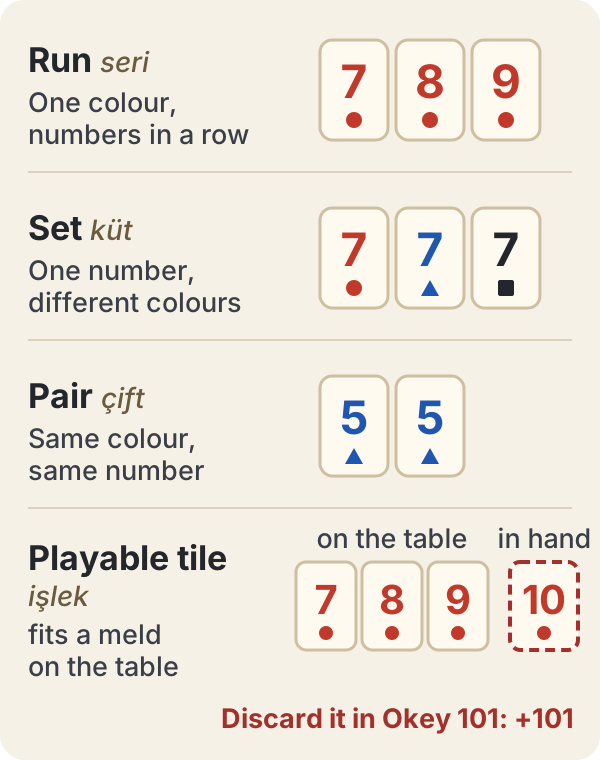
Meld (per)
A per (say pehr) is a meld: a group of tiles that follows the rules, either a run or a set. A pair is counted apart; in Okey 101, once someone has opened with pairs, pairs go on the table too.
- A run or a set has at least three tiles; an okey can stand in for a missing one.
- In Okey 101 melds go down on the table; in Classic Okey they stay on your rack until the hand ends.
On oyna.app you select the tiles and press + Make Group (pairs too). If they do not form a group, the table says: “These tiles do not form a valid group (run / set / pair).”
Run (seri)
A seri is a run: at least three tiles of one colour in an unbroken sequence, such as Red 7 · 8 · 9. A run can stretch from 1 to 13.
Whether the 1 may follow the 13 depends on the game. On oyna.app:
| Run | Okey 101 | Classic Okey |
|---|---|---|
| 1-2-3 | Valid | Valid |
| 11-12-13 | Valid | Valid |
| 12-13-1 | Not valid | Valid |
| 13-1-2 | Not valid | Not valid |
The details: the 1 is only the lowest tile in Okey 101.
In an opening a run counts the sum of its numbers: Red 10 · 11 · 12 · 13 = 46. In oyna.app’s Okey 101 a run on the table grows only at its ends, and an okey in it never moves.
Set (küt)
A küt is a set: three or four tiles of one number in different colours, such as Red 7 · Blue 7 · Black 7. A set of three is also called an üçlü (a three), and a set of four a dörtlü (a four).
- A set never holds the same colour twice: Blue 10 · Red 10 · Blue 10 is not a set.
- A set has four tiles at most; once all four colours are there, nothing more goes on it.
- In an opening a set counts its number × the number of tiles: a 9 in all four colours is 36.
Pair (çift)
A çift is a pair: two tiles of the same colour and the same number, such as two Blue 5s. Blue 5 and Red 5 are not a pair.
- An okey pairs with any tile, and two okeys make a pair.
- Two false jokers make a pair as well, because both play as the same tile (two Yellow 6s, if the indicator is Yellow 5).
- In Okey 101 you can open with at least five pairs; in Classic Okey you can finish with seven. Both are going for pairs.
During the game
Opening (açmak, el açmak)
Açmak (to open; say ahch-mahk), or el açmak (opening your hand), means laying your melds on the table for the first time in Okey 101. You need runs and sets (mixed, if you like) worth at least 101 points in one turn, or at least 5 pairs.
An example opening:
| Meld | What it counts |
|---|---|
| Red 10 · 11 · 12 · 13 | 46 |
| Black 9 · Blue 9 · Red 9 · Yellow 9 | 36 |
| Blue 7 · okey · Blue 9 (the okey as Blue 8) | 24 |
| Total | 106: you can open |
To open on oyna.app, build your melds on your rack after drawing; each time you add one the total is shown (“Group added — total 106: you can open now.”). Press Open, keeping at least one tile to discard, then discard.
- Runs and sets may be mixed in one opening; pairs do not mix with them.
- After opening you can lay tiles off and take an okey back. A pairs opener’s only new melds are pairs.
- You may take the tile on your left only if you can use it that turn; on oyna.app a lock (🔒) shows on a pile you cannot take from (the rule).
- If you lay your whole hand down in one turn and finish, you need not reach 101. If you have still not opened when the hand ends, you score 202 (404 or 808 after a doubled finish: the finishes table).
At some tables a player who opens short of 101 takes the tiles back and scores 101; on oyna.app the opening is simply not accepted, and nothing is scored. Classic Okey has no opening. All the rules: how many points you need to open.
Raising the opening (katlamalı 101)
Katlamalı 101 (say kaht-lah-mah-luh yewz-beer) is an opening rule some tables play: raising the opening. Each player who opens must open with more points than the player who opened before them.
- After an opening of 120 you need at least 121, and the next player must beat you; after 6 pairs, 7.
- The details vary: in a team game, for example, whether you must beat your partner too.
oyna.app does not play it: everyone opens with at least 101 points or 5 pairs. Do not confuse it with the doubled finishes, which every Okey 101 table on oyna.app plays (the finishes table).
Laying off (işlemek)
İşlemek (say ish-leh-mek) is laying off: adding a tile from your hand to a meld on the table. You can lay off on your own melds and on other players’.
- You must have opened first (the turn you open counts); a pairs opener can lay off on runs and sets too.
- On a run: at one of its ends. With Red 7 · 8 · 9 on the table, Red 6 or Red 10.
- On a set: a missing colour. Yellow 9 on Black 9 · Red 9 · Blue 9. Nothing goes on a set of four, or on a pair.
- An okey: at an open end of a run, or on a set that is missing a colour.
- You cannot lay off your last tile: you finish by discarding it.
On oyna.app there is no limit: on Black 8 · 9 · 10 you can lay off Black 7, 6 and 5 in one turn. In one written tournament rule a pairs opener may lay off at most two tiles at a time. Classic Okey has no laying off.
Playable tile (işlek)
An işlek tile (say ish-lek) is a playable tile: one that a meld on the table could take. In Okey 101, discarding a playable tile costs +101, and the rule applies to players who have not opened too.
| Group on the table | Playable tiles | Not playable, for example |
|---|---|---|
| Red 7 · 8 · 9 | Red 6, Red 10 | Red 5, Blue 10 |
| Black 9 · Red 9 · Blue 9 | Yellow 9 | Black 9 (that colour is there) |
| Black 11 · Red 11 · Blue 11 · Yellow 11 | None: the set is full | — |
| Blue 4 · okey · Blue 6 (the okey as Blue 5) | Blue 3, Blue 7 | Blue 5, the tile in the okey’s place |
| Red 8 · Red 8 (a pair) | None: nothing goes on a pair | — |
Worth knowing:
- The okey costs +101 to discard whether or not a meld could take it; as your last tile it is finishing with the okey, not a penalty.
- A false joker is playable only if a meld could take the tile it plays as (a Yellow 6, for example).
- The last tile you discard to finish is never charged.
On oyna.app a +101 penalty card comes up before such a discard: Keep it or Discard (+101). At some tables the penalty is charged only when another player spots the tile and says so. Classic Okey has no such penalty.
Discarding (yere atmak)
Yere atmak (say yeh-reh aht-mahk; literally throwing to the floor) is discarding: throwing a tile from your rack to end your turn. Every turn ends with a discard, and the player who finishes the hand discards their last tile too.
Yer, the floor, means the table: melds laid “on the floor” are on the table.
- The player on your right may take your discard; you may take your left-hand neighbour’s.
- In Okey 101 the okey and a playable tile cost +101 each to discard (never as your last tile). A tile taken from your left cannot go straight back; in Classic Okey it can.
- On oyna.app each player’s discards form a pile of their own, its top tile and count showing.
Finishes
On oyna.app a hand of Okey 101 ends with these scores. H is the sum of the tiles left in a player’s hand; okeys are not part of it.
| Finish | Finisher | Player who opened with runs or sets | Player who opened with pairs | Player who never opened |
|---|---|---|---|---|
| Ordinary | −101 | H | 2 × H | 202 |
| With the okey | −202 | 2 × H | 4 × H | 404 |
| After a pairs opening | −202 | 2 × H | 4 × H | 404 |
| After a pairs opening, with the okey | −404 | 4 × H | 8 × H | 808 |
| In one go | −202 | — | — | 404 |
| In one go, with the okey | −404 | — | — | 808 |
A player who opened also scores 101 for each okey left in hand. That 101 is never doubled, and neither are the +101s for discarding the okey or a playable tile.
For example, you finish with the okey. A player who opened with runs has Blue 3 and Blue 4 left: they score 2 × 7 = 14. Had they held an okey as well, they would score 14 + 101 = 115. The figures in the table were worked out with the rules above and checked one by one against oyna.app’s own end-of-hand scoring.
The rule for each finish: types of finish in Okey 101.
In Classic Okey the points count down. When a hand is finished, the other players (the other team, in Team Okey) lose:
| Finish | The other players |
|---|---|
| Ordinary | −2 |
| With the okey | −4 |
| Seven pairs | −4 |
| Seven pairs, with the okey | −8 |
When a player shows the indicator, the other three players (the other team, in Team Okey) also lose 1 point.
Finishing with the okey (okeyle bitmek)
Okeyle bitmek (say oh-kay-leh bit-mek) is finishing with the okey: throwing the okey as your last tile to end the hand. It is also called okey atmak (throwing the okey) or okey dışarı (okey out).
Take care: okey atmak can also mean throwing the okey away mid-hand, which in Okey 101 is no finish but a +101 penalty.
In Okey 101 the finish is doubled: −202 for the finisher, the others’ tile penalties doubled, 404 for a player who never opened (a pairs opener finishing this way: −404 and 808). In Classic Okey the others lose 4 points instead of 2, or 8 with seven pairs. Finishing with a false joker is not a finish with the okey.
Going for pairs (çifte gitmek)
Çifte gitmek (say chif-teh git-mek) is going for pairs: collecting pairs instead of runs and sets, to open with at least five in Okey 101 or finish with seven in Classic Okey.
Going for pairs in Okey 101 on oyna.app:
- You open with at least 5 pairs, face up on the table; no points total is needed.
- In that hand you cannot put down runs or sets, only more pairs, and you can lay tiles off on the runs and sets on the table.
- To finish you must lay off at least one tile on a run or set on the table, or take the okey from a three-tile set with an okey by putting down all its missing colours. Pairs go down two tiles at a time, so on their own they never leave you with the single tile you discard to finish. Laying off one tile, like putting down two tiles to take an okey, leaves you one tile fewer.
- Once someone has opened with pairs, runs-and-sets openers may lay pairs too.
- If all four players open with pairs, the hand is void and the same dealer deals again.
After a pairs opening your leftover tiles count double if someone else finishes, and your own finish is doubled (−202). In Classic Okey seven pairs (an okey may complete one) cost the others 4 points, 8 with the okey last. Some tables turn the discards face up once a player goes for pairs.
Going out in one go (elden bitmek)
Elden bitmek (say el-den bit-mek; elden means from the hand) is going out in one go: laying your whole hand down in a single turn, without having opened before, and discarding the last tile. On oyna.app it counts only while nobody else has opened.
- You need not reach 101: all your tiles just have to go down as runs or sets.
- The finisher scores −202, and every other player 404. If the last tile is the okey, −404 and 808.
- If someone else opened earlier, the same move is an ordinary finish, or a finish with the okey if the last tile is the okey.
- You cannot go out in one go with pairs: a player who opened with pairs can finish only by laying a tile off on a run or set on the table or by taking the okey from a three-tile set with an okey, and when you go out in one go, nobody has a run or a set on the table.
- Classic Okey has none: nobody opens there.
Tables define it differently; one written tournament rule defines it as oyna.app does, and also calls it “throwing 800”.
Kafa atmak
Kafa atmak (say kah-fah aht-mahk; literally to headbutt) is the name some tables give a finish. Which finish, and what it scores, varies; agree on it before you start. oyna.app has no finish by this name: its finishes are those in the finishes table, and the result card names each, for example “(with the okey!)”, “(with pairs!)” or “(the whole hand at once!)”.
Coloured okey (renkli okey) and finishing in one colour
Renkli okey (coloured okey; say renk-lee oh-kay), also called sayılı okey (counted okey), is a game some tables play: when someone finishes, the others turn their racks face up and score the numbers of the tiles left out of melds, doubled after going for pairs. Renkten bitmek, finishing in one colour (every tile the same colour), scores extra at some tables. oyna.app plays neither.
Scoring
Penalty points (ceza puanı)
Ceza puanı (say jeh-zah poo-ah-nuh) are penalty points: in Okey 101, the points each player scores at the end of every hand. They add up from hand to hand, and at the end of the match the lowest total comes first. The finisher scores a minus figure: −101 for an ordinary finish.
- On oyna.app a match of Okey 101 ends when a player’s total reaches 1,000.
- Classic Okey has no penalty points: everyone counts down from 20 (a table can also start at 30, 40 or 50). When a player reaches 0 the match ends, and the highest score wins.
- These points are okey’s own; they have nothing to do with the credits of an oyna.app account.
What varies from table to table
The differences worth knowing for these terms:
| Topic | At some tables | On oyna.app |
|---|---|---|
| Kafa atmak | Names a finish, which varies | No such finish |
| Raising the opening | Each opening beats the last | 101 points or 5 pairs for everyone |
| Playable-tile penalty | Only if someone calls it | Always; you are asked first |
| Opening short of 101 | Tiles back, 101 scored | Not accepted, nothing scored |
| The indicator (Okey 101) | May finish a hand once the stock is empty | Never taken, worth nothing |
| Going for pairs | The discards turned face up | Every pile’s top tile shows |
| Laying off | Two tiles at a time for a pairs opener (one tournament rule) | No limit |
| Coloured okey, one-colour finish | Played | Neither |
Agree on your table’s rules before you start. On oyna.app the rules are the same against the computer, at an online table and in a private room.
Try the terms at the table
See the terms in play: start Okey 101 or Classic Okey against the computer or at an online table. The full rules: Okey 101 rules and penalties.
At a glance
| Tiles in a set | 106: 4 colours × 13 numbers × 2 = 104 numbered tiles + 2 false jokers |
|---|---|
| The okey | The next number in the indicator's colour; after a 13 comes the 1 of that colour. A set has 2 okeys. |
| Tiles left in the stock after the deal | 20 in Okey 101 (106 − 1 indicator − 85), 48 in Classic Okey (106 − 1 − 57) |
| Opening in Okey 101 | Runs and sets worth at least 101 points, or at least 5 pairs, in one turn; at least one tile must be left to discard |
| Discarding a playable tile or the okey (Okey 101) | +101 penalty points; none if that tile is your last and finishes the hand |
| Going out in one go (Okey 101, oyna.app) | The whole hand down in one turn while nobody else has opened: the finisher −202, every other player 404; with the okey as the last tile, −404 and 808 |
| Showing the indicator (Classic Okey) | The three other players lose 1 point (in Team Okey, the other team) |
| Raising the opening | Not on oyna.app: everyone opens with at least 101 points or 5 pairs |
Frequently asked questions
What is a playable tile in okey?
A tile that a meld on the table could take. With Red 7-8-9 on the table, Red 6 and Red 10 are playable. In Okey 101, discarding a playable tile costs +101, unless it is the last tile you throw to finish. Classic Okey has no such penalty.
What is the indicator in okey, and what is it worth?
The tile turned face up at the start of each hand; the okey is the next number in its colour. In Classic Okey it is worth 1 point: a player who holds its twin and shows it makes the other three players (the other team, in Team Okey) lose 1 point. In oyna.app's Okey 101 it scores nothing and only decides the okey.
What does going for pairs mean?
Collecting pairs instead of runs and sets. In Okey 101 it means opening with at least five pairs: you then cannot put down runs or sets in that hand, but you can lay tiles off on the runs and sets on the table. In Classic Okey it means finishing with seven pairs.
What does going out in one go mean, and what does it score?
Laying your whole hand down in a single turn, without having opened before, and discarding the last tile. On oyna.app it counts only while nobody else has opened, and you need not reach 101 points. The finisher scores −202 and every other player 404; with the okey as the last tile, −404 and 808.
Sources
- Okey — Pagat (Card Games / Rummy: the 14-tile game, its indicator, its finishes) (accessed 26 October 2026)
- Okey 101 — Pagat (Card Games / Rummy: opening, laying off, the penalties) (accessed 26 October 2026)
- Okey — Wikipedia (the tiles, the indicator, the false jokers) (accessed 26 October 2026)
- Okey — Vikipedi (bitiş türleri, renkli okey, renge bitme) (in Turkish; accessed 26 October 2026)
- Eşli 101 Turnuvası Oyun Kuralları (PDF) (in Turkish; accessed 23 October 2026)