Tavla Rules: How Turkish Backgammon Is Played
Last updated:
Tavla is the Turkish name for backgammon, and Turkish tavla is played on the same board with the same moves. Two players each race 15 checkers around 24 points with two dice, play doubles four times, hit lone checkers to the bar and bear off once all 15 are home. Unlike western backgammon, the player who wins the opening roll rolls again, there is no doubling cube, and the biggest win is a mars (a gammon), worth 2 points.
This page explains Turkish tavla as oyna.app’s tavla page plays it, listed there as “Tavla (Turkish)”, and sets each rule beside the western game with the doubling cube, “Backgammon (cube)”. The board, the starting position and the moves are the same in both; the scoring and a few details are not. Rules also vary from table to table; the common variations are at the end of the page.
Tavla rules in brief
- Each player rolls one die and the higher number starts. In Turkish tavla the starter then rolls both dice again.
- You move your checkers by the numbers on the two dice. Each die is a separate move; a double is played four times.
- You can never land on a point your opponent holds with two or more checkers.
- Landing on a point with a single opposing checker hits it. The hit checker goes to the bar, and its owner must bring it back in through the other player’s home board before moving anything else.
- When all 15 of your checkers are in your home board, you start bearing them off.
- The first player to bear off all 15 wins the game and scores 1 point, or 2 points (a mars) if the opponent has not borne off any.
- The match goes to the first player to reach the chosen score: a single game, or 2, 3 or 5 points.
The board, the checkers and the direction of play
The board has 24 narrow triangles called points, 12 on each side, split into halves by a bar in the middle. Each player has 15 checkers, and the game is played with two dice. In Turkish a checker is a pul and a point a hane; these and other Turkish words at the board are explained on the page of Turkish backgammon numbers.
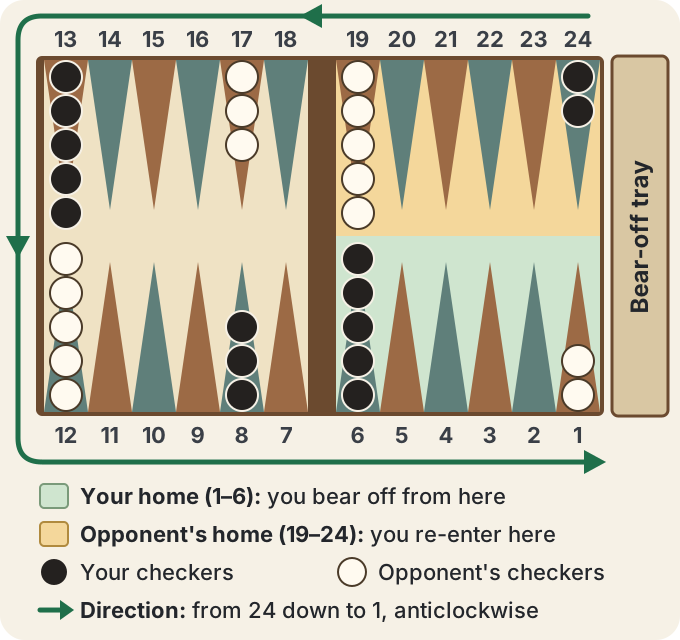
- Point numbers: this page numbers the points from your side, from 1 in the bottom right corner to 24 in the top right. oyna.app’s board shows no numbers, but a screen reader names the points the same way when you move around the board with the keyboard (“Point 13”).
- Your home board: points 1 to 6. You bear off from here.
- Your opponent’s home board: points 19 to 24. A hit checker of yours comes back in here.
- Direction: your checkers move from your 24-point down to your 1-point, anticlockwise on this picture, and never backwards. Your opponent’s checkers make the same journey the other way round, so their home board is your 19 to 24.
- On an upright phone the board may turn sideways to fit the screen; your checkers still follow the same path.
The starting position:
| Point (your numbering) | Your checkers | Opponent’s checkers |
|---|---|---|
| 24 | 2 | — |
| 19 | — | 5 |
| 17 | — | 3 |
| 13 | 5 | — |
| 12 | — | 5 |
| 8 | 3 | — |
| 6 | 5 | — |
| 1 | — | 2 |
Your opponent’s setup mirrors yours, counted with their own numbers: their 24-point is your 1-point. Each new game in a match starts from this position.
The pip count is how far all your checkers still have to travel to bear off: a checker on the 24-point counts 24, one on the 6-point counts 6. At the start both sides have 167 pips: 2 × 24 + 5 × 13 + 3 × 8 + 5 × 6. A roll moves 8.17 pips on average: the 36 possible rolls of two dice add up to 294 pips, doubles counted four times, and 294 ÷ 36 ≈ 8.17. oyna.app shows both players’ pip counts and how many checkers each has borne off beside the board.
Who starts? The opening roll
Each player rolls one die and the higher number starts. If both dice show the same number, they roll again.
- In Turkish tavla the starter picks up both dice and rolls again, then plays that roll. The first roll of a game can therefore be a double, so a game can open with any of 21 different rolls (6 doubles and 15 non-doubles).
- In backgammon the starter plays the two opening dice as they are: if you rolled a 6 and your opponent a 3, you play 6-3. The first move is never a double, so there are 15 possible opening rolls.
Every game of a match starts with a fresh opening roll. On oyna.app the opening dice appear as one die on each side of the board, and the status line says who starts, for example “You start — 6 against 3”.
Moving the checkers
When it is your turn you roll both dice, and each die is a separate move. With 5-2 you move one checker 5 pips and one checker 2 pips; it can be the same checker or two different ones.
Where a checker may land:
| What is on the point? | Can you land there? |
|---|---|
| Nothing | Yes |
| Your own checkers | Yes, any number of them |
| A single opposing checker | Yes, and you hit it |
| Two or more opposing checkers | No |
- One checker, both dice: the stop in between has to be open as well. To move 7 pips with 5-2, the point 5 pips or 2 pips away must not be held by your opponent.
- You must use both dice if you can. If only one die can be played, you play that one. If either die could be played but not both, you must play the larger.
- If neither die can be played, your turn passes. On oyna.app the dice stay on the board for two seconds and the status line says “No legal move with these dice — your turn passes.”
Making a move on oyna.app:
- When it is your turn, press “Roll”.
- Tap a checker and then a highlighted point, or drag the checker there. To move the total of both dice with one checker, take it straight to the point where it ends.
- Changed your mind? “Undo” takes back your last move of the turn.
- Press “Confirm” when the turn is done. With “Auto-confirm” switched on, the turn is confirmed for you.
When a move breaks a rule, the board says why, for example “This checker cannot move with these dice.” or “Enter your checker from the bar first.”
Doubles: how many times do you move?
When both dice show the same number, you play that number four times. With 4-4 you move 4 pips four times: one checker 16 pips, two checkers 8 pips each, four checkers 4 pips each, or any mix of these.
- If you cannot play all four, you play as many as you can.
- The longest roll is double six, 24 pips in a single turn. Turkish players call it düşeş (double six), and 6-5 is şeşbeş (six-five); every roll has a name like these, listed on the page of Turkish backgammon numbers.
- Any roll is a double 1 time in 6: 6 of the 36 ways two dice can fall.
Points and making a point
A point where you have two or more checkers is yours: your opponent cannot land there. They may jump over it with a die, but never stop on it. Turkish players call such a point a kapı (a made point), literally a door: you have shut it. You make a point by bringing a second checker onto it.
- A checker standing alone on a point, a blot, can be hit: if your opponent lands there, it goes to the bar.
- The more points you hold in your home board, the harder it is for your opponent’s hit checkers to come back in, and the other way round (the odds).
- Six points in a row stop every checker behind them: no die moves a checker more than 6 pips in one step.
Hitting, the bar and hit-and-run
Landing on a point with a single opposing checker hits it. The hit checker is placed on the bar, the divider in the middle of the board. Hitting is never compulsory: you may choose any legal move.
Hitting a blot is allowed everywhere, your own home board included. Hit-and-run (vur kaç: hitting, then moving the same checker on with the other die) is also allowed in your own home board here, though some traditional descriptions forbid it inside the home board.
If one of your checkers is on the bar, Turkish players call it a kırık pul (a checker on the bar), literally a broken checker:
- It must come back in first. While it waits on the bar you cannot move anything else.
- It enters through your opponent’s home board: a roll of 1 enters on your 24-point, a roll of 6 on your 19-point (25 minus the die).
- You cannot enter on a point your opponent holds. If a single opposing checker stands there, entering hits it.
- Once it is in, you play the other die with any checker. With several checkers on the bar, all of them must enter before anything else moves.
- If no die lets you enter, your turn passes.
What are the chances of entering? If your opponent holds k points in their home board, you fail to enter only when both dice show one of those points. That happens with a chance of (k/6)², so you enter with a chance of 1 − (k/6)².
| Points held in the opponent’s home board | Rolls that enter (of 36) | Chance to enter |
|---|---|---|
| 0 | 36 | certain |
| 1 | 35 | 97.2% |
| 2 | 32 | 88.9% |
| 3 | 27 | 75% |
| 4 | 20 | 55.6% |
| 5 | 11 | 30.6% |
| 6 | 0 | 0% |
These figures were counted by trying each of the 36 rolls in oyna.app’s tavla engine.
When the home board is completely closed: if your opponent holds all six points of their home board, Turkish tavla does not make you roll. On oyna.app the status line says “Your checker on the bar cannot enter — your turn passes.” and the turn moves on. In backgammon you roll anyway, and the turn passes when you cannot enter.
Bearing off
Once all 15 of your checkers are in your home board (points 1 to 6), you start bearing them off the board, toplama in Turkish. You cannot bear off while a checker of yours is on the bar or outside your home board.
- You bear off a checker from the point the die shows: with a 4, from your 4-point.
- If that point is empty but you have a checker on a higher point, you must move inside your home board instead. With checkers on your 6 and 5-points and a roll of 3, you move 6 to 3 or 5 to 2.
- If the die is higher than your farthest checker, you bear off from that farthest point. With your highest checker on the 4-point, a 6 bears off from the 4-point.
- You may also move a checker inside your home board when you could bear it off.
- If one of your checkers is hit while you are bearing off, you stop. The hit checker must enter and come all the way home before you continue.
Checkers you bear off go to the tray on the right. The first player to bear off the 15th checker wins the game.
What is a mars, and how many points is it?
You win a mars (gammon) when you bear off all 15 checkers before your opponent has borne off a single one. In Turkish tavla a mars scores 2 points against 1 for an ordinary win, and nothing scores more.
| How did you win the game? | Turkish tavla | Backgammon |
|---|---|---|
| Your opponent had borne off at least one checker | 1 | 1 × cube |
| Your opponent had borne off none (mars or gammon) | 2 | 2 × cube |
| Your opponent had borne off none and still had a checker on the bar or in your home board (backgammon) | 2 | 3 × cube |
- A single checker borne off is enough to save the mars.
- oyna.app’s English screens use the Turkish word for Turkish tavla (“a mars”) and the western words for backgammon (“a gammon”, “a backgammon”). In Turkish the 3-point win is katmerli mars (the triple win), the word oyna.app’s Turkish screens use.
- A mars adds 2 points to the match score. In a 5-point match, if you trail 3–4 and win a mars, the score becomes 5–4 and the match is yours.
- Conceding a game can also cost a mars (below).
Conceding a game or the match
On oyna.app the “Concede” button offers to give up the game or the match: “Concede this game” or “Concede the match”. In a single-game match only “Concede this game” is offered. You can offer even when it is not your turn.
- Concede this game: if your opponent accepts, they win the game. In Turkish tavla it scores 2 (a mars) if you have not borne off any checker, 1 if you have. In backgammon it scores 1 × the cube if you have borne off a checker; if not, 3 × the cube when you still have a checker on the bar or in your opponent’s home board, else 2 × the cube.
- Concede the match: if your opponent accepts, they win the match.
The menu shows what a concession is worth, for example “(−2 · mars)”. Your opponent can accept or decline. If they decline, play goes on, and you cannot offer again until the turn has passed.
How many points does a match go to? Scoring
A tavla match is played to a score: the first player to reach or pass it wins. In Turkish tavla each game is worth 1 or 2 points. In backgammon a game is worth 1, 2 or 3 points, multiplied by the cube (mars). These are the match’s points; they have nothing to do with the credits of an oyna.app account.
On oyna.app the “Match length” choices are a single game, 2, 3 and 5 points, and 5 is chosen to begin with. Because a game of Turkish tavla is worth at most 2 points, a 5-point match takes at least three games when it is played out.
Example: a 5-point match of Turkish tavla
| Game | What happened | Score (you–opponent) |
|---|---|---|
| 1 | You won an ordinary game | 1–0 |
| 2 | Your opponent won a mars | 1–2 |
| 3 | You won a mars | 3–2 |
| 4 | You won an ordinary game | 4–2 |
| 5 | Your opponent won an ordinary game | 4–3 |
| 6 | You won a mars | 6–3, the match is yours |
- The final score can pass the target; the match still ends with that game.
- The score carries over from game to game; a new match starts at 0–0.
Backgammon: the doubling cube and the Crawford rule
The western game, “Backgammon (cube)” on oyna.app, uses the same board, the same starting position and the same moves as Turkish tavla. Some Turkish sources call it modern tavla. Choose it under “Variant” on the tavla page. The differences:
| Turkish tavla | Backgammon | |
|---|---|---|
| First move | The starter rolls both dice again; it can be a double | The starter plays the opening dice; never a double |
| Doubling cube | None | Yes: 2, 4, 8 … 64 |
| Biggest win | A mars: 2 points | A backgammon: 3 × the cube |
| Home board closed | The turn passes without a roll | You roll; the turn passes if you cannot enter |
| Crawford game | None | Yes |
The doubling cube (katlama küpü):
- On your turn, before you roll, you may press “Double”. You can double while the cube is in the middle or when it is yours; you cannot double while your opponent holds it.
- If your opponent presses “Take”, the cube’s value doubles and the cube becomes theirs. Play goes on and you roll.
- If your opponent presses “Pass”, they lose the game for the cube’s value before the double: 1 point if you doubled from 1, 2 points if you doubled from 2.
- At the end of the game the points won are multiplied by the cube: with the cube at 4, a gammon is worth 8 and a backgammon 12.
- The cube goes no higher than 64. A gammon and a backgammon count even if nobody ever doubled.
The Crawford rule: as soon as one player is a single point away from winning the match (on 4 in a 5-point match), the next game is played without the cube, and the board shows “Crawford”. In the games after that the cube is back. A single-game match has no Crawford game.
Time at an online table
At an online table you have 30 seconds for each decision. Rolling is one decision; all your checker moves and undos in a turn count as one more. Answering a double and answering a concession are decisions of their own.
- When the 30 seconds run out, your 90-second time bank starts running. The bank is for the whole match.
- If the bank runs out too, your turn is played for you: the dice are rolled, or a simple move is chosen. A concession offered to you counts as accepted.
- If your time runs out twice in a row, you lose the match. Every move you make yourself in between resets the count.
- If your connection drops, your seat is kept for 60 seconds, and your clock keeps running meanwhile. If you do not come back, you lose the match.
Playing against the computer has no time limit.
Quick answers
| Question | Answer |
|---|---|
| How many players? | Two, with 15 checkers each. |
| Which way do the checkers move? | Yours go from your 24-point to your 1-point, anticlockwise; your opponent’s the other way (the board). |
| Can a checker move backwards? | No. A hit checker goes to the bar and comes back in through the opponent’s home board. |
| Can you jump over a made point? | Yes. But when one checker uses both dice, the stop in between cannot be a made point (moving). |
Rules vary from table to table
Tavla is not played the same way at every table, and agreeing on the rules before you sit down saves an argument later. On oyna.app the rules are the ones on this page. Elsewhere you may meet these differences:
- Hit-and-run in your own home board: Hit-and-run (vur kaç: hitting, then moving the same checker on with the other die) is also allowed in your own home board here, though some traditional descriptions forbid it inside the home board.
- The shape of a match: some descriptions play tavla as five games, and the first to win three takes it. On oyna.app a match goes to a score, and a mars counts 2.
Learn by playing
The rules sink in fastest at the board. Open tavla and play a few games against the computer first: when a move breaks a rule, the board tells you why, and “Undo” lets you change your move. To try the game with the cube, choose “Backgammon (cube)” on the same page. After tavla, have a look at chess or Okey 101.
The rules in short
| Board and checkers | 24 points, 15 checkers for each player, two dice |
|---|---|
| Starting position | Counted from your side: 2 checkers on your 24-point, 5 on the 13-point, 3 on the 8-point and 5 on the 6-point |
| Pip count | 167 for each side at the start |
| Who starts | Each player rolls one die and the higher number starts; in Turkish tavla the starter rolls both dice again, in backgammon the starter plays the two opening dice |
| Doubles | Played four times |
| Using the dice | Play both dice when you can; if only one can be played, play that one; if either can be played but not both, play the larger |
| Hitting | A lone checker can be hit on any point, your own home board included, and the hitting checker may move on with the other die |
| A checker on the bar | Enters before anything else moves: a roll of n enters on your point 25 − n, in the opponent's home board (19–24) |
| When the opponent's home board is closed | Turkish tavla: the turn passes without a roll; backgammon: you roll, and the turn passes when you cannot enter |
| Bearing off | Once all 15 checkers are home: from the point the die shows; with a die higher than your farthest checker, from that farthest point |
| Mars | Turkish tavla: 2 points, the biggest win; backgammon: a gammon 2, a backgammon 3, both times the cube |
| Match length | A single game, or 2, 3 or 5 points; 5 by default |
| Time at an online table | 30 seconds for each decision, plus a 90-second time bank for the whole match |
Frequently asked questions
How many points is a mars in tavla?
2 points. You win a mars when you bear off all 15 checkers before your opponent has borne off a single one; an ordinary win is 1 point, and Turkish tavla has no bigger win. In western backgammon the same win is called a gammon (2 points), a backgammon is worth 3, and both are multiplied by the doubling cube.
Do you play doubles four times in tavla?
Yes. With 5-5 you move 5 pips four times, all with one checker or spread over several. If you cannot play all four, you play as many as you can. Double six moves 24 pips in all, the longest roll in the game.
Who starts in tavla?
Each player rolls one die and the higher number starts; equal dice are rolled again. In Turkish tavla the starter then rolls both dice for the first move, so the first roll can be a double. In western backgammon the starter plays the two opening dice instead.
Can you hit in your own home board in tavla?
Yes. Hitting a blot is allowed everywhere, your own home board included. Hit-and-run is also allowed in your own home board here, though some traditional descriptions forbid it inside the home board.
How many points do you play to in tavla?
On oyna.app you choose a single game or a match to 2, 3 or 5 points; 5 is the default. A game in Turkish tavla is worth 1 or 2 points, so a 5-point match takes at least three games, unless a player concedes the match or loses it on time or by leaving an online table.
Sources
- Tavla — Wikipedia (the opener rolls again, a gammon worth 2, hit-and-run not played in the home board) (accessed 26 October 2026)
- Backgammon — Wikipedia (the moves, entering from the bar, bearing off, gammon and backgammon, the doubling cube) (accessed 26 October 2026)
- Tavla — Vikipedi (a game of five rounds, the first to three) (in Turkish; accessed 26 October 2026)