Turkish Backgammon Numbers: The Names of All 21 Dice Rolls
Last updated:
In Turkish backgammon, called tavla, each of the 21 different rolls of two dice has a name of its own. The names are built from the Persian numbers one to six, and four of them mix in a Turkish number word. Doubles put the word for two in front of the number, three doubles have names of their own, and mixed rolls usually say the larger number first. The table below gives all 21, with how to say each one and what it means word for word.
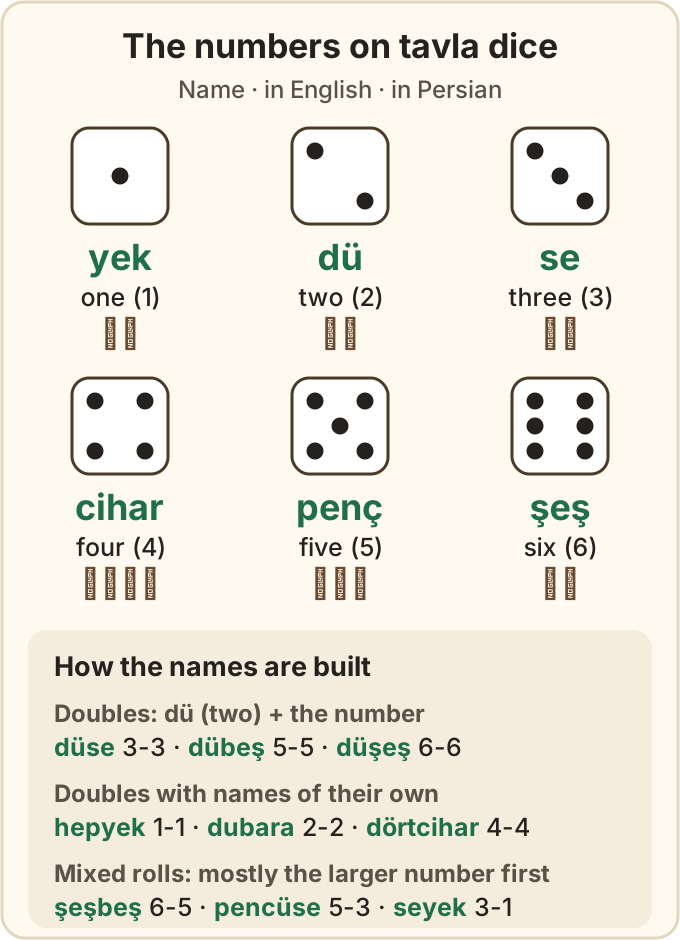
The six number words behind the names are Persian: yek (one), dü (two), se (three), cihar (four), penç (five) and şeş (six). The names are built from them like this:
- Three doubles put dü, “two”, in front of the number: düse (3-3), dübeş (5-5) and düşeş (6-6).
- The other three doubles have names of their own: hepyek (1-1), dubara (2-2) and dörtcihar (4-4).
- Mixed rolls usually say the larger number first: şeşbeş (6-5), pencüse (5-3), seyek (3-1).
- Spellings vary. The Turkish Language Association’s dictionary writes each name as one word (şeşbeş, düşeş); other sources split them: şeş beş, dü şeş.
Calling out the rolls by these names is a tradition among tavla players. Below are all 21 with a pronunciation guide, where the number words come from, how the names are put together, the odds of each roll and a few more Turkish words you will hear at the board.
All 21 rolls: names, pronunciation and meaning
The table runs from double one to double six. “Turkish name” is the dictionary spelling. “Say it” is a rough guide for English speakers (the letters). “Word for word” is what the name says, and “Pips” is how far the roll moves you in all; a double is played four times.
| Roll | Turkish name | Say it | Word for word | Pips |
|---|---|---|---|---|
| 1-1 | hepyek | hep‑yeck | all ones | 4 |
| 2-1 | düyek or yekdü | dew‑yeck, yeck‑dew | two-one, one-two | 3 |
| 2-2 | dubara | doo‑baa‑raa | again, twice | 8 |
| 3-1 | seyek | seh‑yeck | three-one | 4 |
| 3-2 | sebayüdü | seh‑baa‑yew‑dew | three with two | 5 |
| 3-3 | düse | dew‑seh | two threes | 12 |
| 4-1 | ciharıyek | jee‑haa‑ruh‑yeck | four-one | 5 |
| 4-2 | ciharıdü | jee‑haa‑ruh‑dew | four-two | 6 |
| 4-3 | ciharıse | jee‑haa‑ruh‑seh | four-three | 7 |
| 4-4 | dörtcihar | durt‑jee‑har | four fours | 16 |
| 5-1 | pencüyek | pen‑jew‑yeck | five-one | 6 |
| 5-2 | pencüdü | pen‑jew‑dew | five-two | 7 |
| 5-3 | pencüse | pen‑jew‑seh | five-three | 8 |
| 5-4 | beşcihar or ciharıpenç | besh‑jee‑har, jee‑haa‑ruh‑pench | five-four, four-five | 9 |
| 5-5 | dübeş | dew‑besh | two fives | 20 |
| 6-1 | şeşyek | shesh‑yeck | six-one | 7 |
| 6-2 | şeşüdü | shesh‑ew‑dew | six-two | 8 |
| 6-3 | şeşüse | shesh‑ew‑seh | six-three | 9 |
| 6-4 | şeşcihar | shesh‑jee‑haar | six-four | 10 |
| 6-5 | şeşbeş | shesh‑besh | six-five | 11 |
| 6-6 | düşeş | dew‑shesh | two sixes | 24 |
In a double, dü means “two”: düşeş is literally “two sixes”, both dice showing six. In hepyek the word hep, “all”, does the same job: all ones.
Where do the names come from?
From Persian. The Turkish Language Association’s dictionary gives each of the six number words as Persian in origin, and lists each of them on its own as well:
| Die | At the board | In English | In Persian today |
|---|---|---|---|
| 1 | yek | one | the same word (یک) |
| 2 | dü | two | “do” (دو) |
| 3 | se | three | the same word (سه) |
| 4 | cihar | four | “chahâr” (چهار) |
| 5 | penç | five | “panj” (پنج) |
| 6 | şeş | six | “shesh” (شش) |
The romanised Persian in the last column is the one the number references use; Turkish spelling writes the same sounds with its own letters.
- Hep is Persian too. The dictionary traces it to a Persian word, so hepyek is Persian from end to end.
- Dubara comes from the Persian words for “two” and “time”. In Persian, dubāra means “again” or “twice”.
- Sebayüdü is traced to the Persian for “three” and bā, “with”: roughly “three with two”.
Names with a Turkish number in them. Four names put a Turkish number word beside a Persian one: dört (four) and beş (five).
| Roll | Name | The Turkish word in it |
|---|---|---|
| 4-4 | dörtcihar | dört, four |
| 5-4 | beşcihar | beş, five |
| 5-5 | dübeş | beş, five |
| 6-5 | şeşbeş | beş, five |
So five is said two ways. In 5-1, 5-2 and 5-3 the Persian penç is used: pencüyek, pencüdü, pencüse. In 5-5 and 6-5 the Turkish beş is used: dübeş, şeşbeş. And 5-4 has both: ciharıpenç and beşcihar.
What does shesh besh mean?
“Shesh besh” is the roll 6-5, şeşbeş in Turkish spelling: şeş is six in Persian and beş is five in Turkish. The rhyming pair is known well beyond Turkey. Across the Eastern Mediterranean, players call out their rolls in this mix of Persian and Turkish numbers, and in parts of the region backgammon itself is known as shesh besh. If you have heard the game called that, this is the roll the name comes from.
How the names are put together
You do not have to learn the 21 names one by one. Know the six Persian numbers and you can build 14 of the names yourself; the other seven are worth learning separately.
- Look at the dice. The same number on both is a double; two different numbers make a mixed roll.
- For a double, put dü in front of the number: 3-3 is düse, 6-6 is düşeş. In 5-5 the Turkish beş takes the place of the Persian penç: dübeş. Three doubles have names of their own: hepyek (1-1), dubara (2-2) and dörtcihar (4-4).
- For a mixed roll, say the larger number first, then the smaller: 6-3 is şeş and se, so şeşüse. In some names a sound slips in between the two numbers, like the ü in şeşüse (below).
- Remember the three mixed rolls that break the pattern:
- 3-2 sebayüdü: the Persian bā, “with”, sits between the three and the two.
- 6-5 şeşbeş: five here is the Turkish beş, not the Persian penç.
- 5-4 beşcihar or ciharıpenç: the first uses the Turkish beş; the second says the smaller number first.
2-1 follows the pattern, but it also has a second name that starts with the smaller number: yekdü.
The sound in between. Some dictionary names slip a short vowel between the two numbers: şeşüdü, şeşüse, pencüse, ciharıdü, ciharıse. Others do not: şeşyek, şeşcihar, şeşbeş, seyek. Other sources mark that vowel with a hyphen and sometimes spell it with a different vowel, so the same roll can look quite different in print.
How to say them, and how they are spelt
There is no single spelling that everyone uses. This page follows the dictionary’s one-word spellings and gives the most common others below. The “Say it” column of the table writes each name in English letters; these are the Turkish letters behind it:
| Letter | Sounds like | Written in “Say it” as |
|---|---|---|
| c | j in “jam” | j |
| ç | ch in “chair” | ch |
| ş | sh in “shoe” | sh |
| ü | “ee” said with rounded lips, as in French “tu” | ew |
| ö | “ur” in “fur”, without the r | ur |
| ı | the “a” in “about” | uh |
- Long vowels. The dictionary marks the a of cihar as long, and in the names ciharıyek, ciharıdü, ciharıse, ciharıpenç and şeşcihar as well; the table writes it “aa”. Dubara has both of its a’s long, and sebayüdü its a.
- One word or two? The dictionary writes hepyek, düşeş and şeşbeş; elsewhere you will meet hep yek, dü şeş and şeş beş, and in the same way dü se, dört cihar and dü beş. They name the same rolls: hep yek is all ones, dü şeş two sixes, şeş beş six-five, dü se two threes, dört cihar four fours and dü beş two fives.
- Penç or penc? The dictionary lists the number with a ç, but writes the names pencüyek, pencüdü and pencüse with a c, said like a j: pen-jew-yeck. Ciharıpenç keeps the ç.
Do not be surprised if a player at the table says a name differently: the names change from source to source, and from player to player.
How likely is each roll?
Two dice, each with six faces that come up equally often, fall in 36 ways (6 × 6). A double turns up in only one of those 36 ways; a mixed roll in two. Six-five comes up when the first die shows 6 and the second 5, and also the other way round, so it is twice as likely as double six.
| Kind of roll | How many | Each, out of 36 | All together |
|---|---|---|---|
| Doubles (double one to double six) | 6 | 1 (2.8%) | 6/36 = 16.7% |
| Mixed rolls (two-one to six-five) | 15 | 2 (5.6%) | 30/36 = 83.3% |
| Total | 21 | 36/36 |
Some double turns up 1 time in 6; a particular mixed roll, six-five for instance, 1 time in 18.
How we counted. A short script went through the 36 outcomes of two dice one by one, put each under its roll with the larger number first, and counted how often each roll appeared. The 36 outcomes gave 21 rolls: each of the 6 doubles once, each of the 15 mixed rolls twice.
How far does each roll move?
With a mixed roll you play the two numbers separately; six-five moves you 11 pips in all. A double is played four times (doubles).
- The longest roll is double six: 4 × 6 = 24 pips.
- The shortest roll is two-one: 2 + 1 = 3 pips. Double one is short too: 4 × 1 = 4 pips.
- On average a roll moves 8.17 pips: the 36 outcomes add up to 294 pips, and 294 ÷ 36 ≈ 8.17. For comparison, each side starts a game with 167 pips to travel, its pip count.
- No mixed roll moves more than 11 pips (six-five). Four doubles move further: double three (12), double four (16), double five (20) and double six (24).
Sayings from the dice
A few of the names are part of everyday Turkish too. The dictionary gives these:
| Saying | What the dictionary says it means |
|---|---|
| düşeş | Both dice showing six; figuratively, a lucky chance nobody expected |
| düşeş atmak | To roll double six at tavla; figuratively, to pull off an unexpected success |
| dubara | Both dice showing two; in slang, a trick or a con |
| şeşi beş görmek | Literally, to see a six as a five; said mockingly: to see something wrongly |
A few more tavla words
The dice are not the only Turkish words at the board. You will hear these too:
| Word | What it means |
|---|---|
| pul | A checker. Each player has 15. |
| hane | A point: one of the 24 triangles on the board (the board). |
| kapı | A made point, two or more of your checkers on one point; your opponent cannot land there (points). |
| kırık pul | A checker on the bar, after it was hit; it must come back in before anything else moves (hitting). |
| toplama | Bearing off: taking your checkers off the board once all 15 are home (bearing off). |
| mars | The gammon: winning before your opponent has borne off a single checker, worth 2 points in Turkish tavla (mars). |
The dice on oyna.app
oyna.app’s tavla board does not print the names: you see the dice by their pips, and saying the name is up to you.
- The first roll: each player rolls one die and the higher number starts. In Turkish tavla the starter then rolls both dice again, so the first roll can be any of the 21, double six included. The status line shows who starts and the opening dice, for example “You start — 6 against 3”.
- Backgammon (cube): the starter plays the two opening dice. Equal opening dice are rolled again, so these two are never the same: the first roll is one of the 15 mixed rolls, never a double.
- When you roll a double, four dice appear on the board, and each one dims as you play it, so you can see how many moves you have left.
The rest of the rules are on the page of tavla rules: who starts, what happens with a double and how backgammon with the cube differs. You can also learn the names as you play: open tavla and say the name of every roll to yourself.
At a glance
| Different rolls | 21: 6 doubles and 15 mixed rolls |
|---|---|
| Outcomes of two dice | 36 (6 × 6) |
| Chance of one particular double | 1 in 36 (2.8%); any double: 1 in 6 |
| Chance of one particular mixed roll | 2 in 36 (5.6%): six-five comes up as 6-5 or as 5-6 |
| Doubles | Played four times: double six moves 4 × 6 = 24 pips |
| Average roll | 8.17 pips (the 36 outcomes add up to 294) |
| First roll of a game | Turkish tavla: any of the 21, doubles included; backgammon: one of the 15 mixed rolls |
| Where the number words come from | Persian: the six number words are the Persian numerals one to six |
Frequently asked questions
How many different rolls are there in backgammon?
21. Two dice fall in 36 ways. Six of them are doubles, from double one to double six; the other 30 give the 15 mixed rolls, each of them twice (6-5 and 5-6 are the same roll). Turkish tavla has a name for every one of the 21.
What language are the Turkish backgammon numbers?
Persian. The six number words used for the dice are the Persian numerals one to six, and the Turkish Language Association's dictionary gives each of them as Persian in origin. Four of the 21 names mix in a Turkish word for four or five.
What does shesh besh mean?
Six-five. Shesh is six in Persian and besh is five in Turkish, so the phrase names the roll 6-5. In parts of the Eastern Mediterranean the whole game of backgammon is often called shesh besh after it.
Which roll is the most likely in backgammon?
No single roll stands out: each of the 15 mixed rolls comes up 2 times in 36, and each double 1 time in 36. So six-five is twice as likely as double six, and some double turns up 1 time in 6.
Which roll moves the farthest?
Double six: a double is played four times, so it moves 24 pips. Double five moves 20 and double four 16. The longest mixed roll is six-five, 11 pips, and the shortest roll of all is two-one, 3 pips.
Does oyna.app show the names of the rolls?
No. The dice on the board show their pips, and saying the name is up to you. When you roll a double, four dice appear, and each one dims as you play it.
Sources
- Backgammon — Wikipedia (shesh besh, the mixed Persian and Turkish numbers, a table of roll names) (accessed 26 October 2026)
- TDK Güncel Türkçe Sözlük — yek (in Turkish; accessed 26 October 2026)
- TDK Güncel Türkçe Sözlük — dü (in Turkish; accessed 26 October 2026)
- TDK Güncel Türkçe Sözlük — se (in Turkish; accessed 26 October 2026)
- TDK Güncel Türkçe Sözlük — cihar (in Turkish; accessed 26 October 2026)
- TDK Güncel Türkçe Sözlük — penç (in Turkish; accessed 26 October 2026)
- TDK Güncel Türkçe Sözlük — şeş (in Turkish; accessed 26 October 2026)
- TDK Güncel Türkçe Sözlük — hep (in Turkish; accessed 26 October 2026)
- TDK Güncel Türkçe Sözlük — hepyek (in Turkish; accessed 26 October 2026)
- TDK Güncel Türkçe Sözlük — düyek (in Turkish; accessed 26 October 2026)
- TDK Güncel Türkçe Sözlük — yekdü (in Turkish; accessed 26 October 2026)
- TDK Güncel Türkçe Sözlük — dubara (in Turkish; accessed 26 October 2026)
- TDK Güncel Türkçe Sözlük — sebayüdü (in Turkish; accessed 26 October 2026)
- TDK Güncel Türkçe Sözlük — ciharıdü (in Turkish; accessed 26 October 2026)
- TDK Güncel Türkçe Sözlük — beşcihar (in Turkish; accessed 26 October 2026)
- TDK Güncel Türkçe Sözlük — ciharıpenç (in Turkish; accessed 26 October 2026)
- TDK Güncel Türkçe Sözlük — şeşbeş (in Turkish; accessed 26 October 2026)
- TDK Güncel Türkçe Sözlük — düşeş (in Turkish; accessed 26 October 2026)
- TDK Güncel Türkçe Sözlük — düşeş atmak (in Turkish; accessed 26 October 2026)
- TDK Güncel Türkçe Sözlük — şeşi beş görmek (in Turkish; accessed 26 October 2026)
- Wiktionary — دوباره (Persian) (accessed 26 October 2026)
- Wiktionary — با (Persian) (accessed 26 October 2026)
- Persian numbers — Of Languages and Numbers (accessed 26 October 2026)